Over the past week, wherever you may go there is one phrase that has been on the lips of many Ghanaians and that phrase is Sika mp3 dede. The president of Ghana, H.E Nana Addo Dankwa Akufo-Addo in his address to the Nation on 30th October, 2022 about the country's current economic situation mentioned that he was aware of the fact that our economy is in great difficulty. In his address, he encouraged citizens to support the government after highlighting some steps his government was taking to alleviate the country during this economic crisis.
Noteworthy, for most people who listened to or heard about the address was the president's remark that Where there is chaos, where there is noise, where there is unrest, you will not find money. If you talk down your money, it will go down which he simply referred to as Sika mp3 dede (money does not like noise). His advice to all of us to keep calm during such tumultuous times has backfired because the citizens are frustrated with the high cost of living. On the contrary, the deafening roar of Ghana's ailing economy is what is unleashing a social unrest that is not so silent.
The president and his government should have taken into consideration that because there is no money, there is unrest and where unrest is, there is chaos which in turn leads to anarchy or lawlessness. This reality we face in Ghana is inconsistent with his advice stated above.
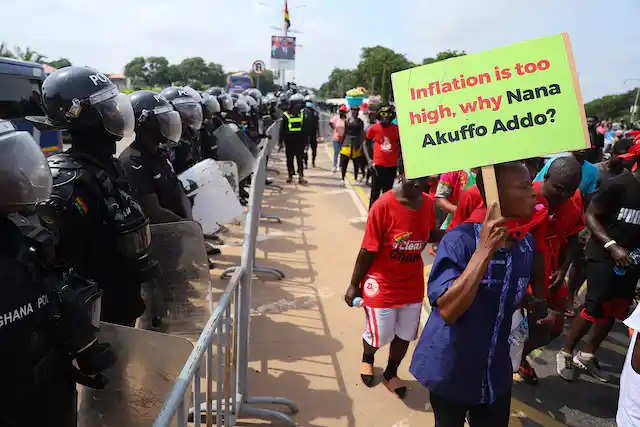
In our homes, in our communities, on the streets, at the market places, in the 'trotros' and taxis and all over social media, people are angry. They are expressing their dissatisfaction about the economy which includes, the high cost of fuel, the high cost of importing goods, the increased transport prices and the increased prices of basically everything. One does not need to be a financial expert to know that the cost of living now is dire. One does not also have to be a security practitioner to know that human security in Ghana is under a threat: People do not feel protected, their aspirations and strengths are being cut down, their survival and livelihoods have been diminished.
Aside from the obvious increase in social unrest, other security issues brought on by the current economic crisis include higher unemployment rates as a result of business closures, an increase in inequality and violent crimes, encouragement of black-market activity due to black market dollar rates, and a rise in political discontent that fosters vigilantism. Unpacking the economic crisis also highlights how citizens' feelings of dissatisfaction can breed a sense of alienation, which is the leading cause of suicide and the starting point for becoming a violent extremist.
These personal insecurities, community insecurities and general human insecurities have been exacerbated because we are facing crisis after crisis. People on social and traditional media are urging the government to take decisive actions. The rhetoric and quotes are not going to solve the crisis nor absolve the government of some drastic actions that need to be taken to release the pressure on our economy.
The public has little faith in the government. There is no question that the undervalued cedi is a result of businesses transacting in foreign currencies due to a lack of confidence in the government's ability to appreciate our currency. Also, due to their lack of confidence, traders are overpricing goods out of concern that they will lose money in the future since, in their words, "yesterday's price is not today's price." These are only a few examples of what is going on in our economy because there is no hope. This vicious cycle is because for a very long time, our economy has only served the best interest of those wielding power.
I stand with my fellow Ghanaians to implore the President and his administration to remain committed to their mission of rescuing Ghana from the grips of the economic crisis by whatever means required, even if the necessary actions are unpleasant to his administration in the short term, sticking to the principle that human security comes before state-centric security.
Source: Dorothy Barnes